Wednesday, July 4, 2012

The Magic of White Space

Have you ever wondered why some books are such a mission to read, and others ...well, you literally fly through the story, swept along by a great plot and gripping elements. The answer is quite simple and who better to explain why than Randy Ingermanson, who offers loads of simple writing advice.

Creating White Space Magic

One of the most common mistakes I see when I critique manuscripts is that the paragraphs are too long. When I see a dense page of text that has only three or four paragraphs, I suspect the pace is going to be slow and the writing is going to be boring. When I see a page with a lot of white space, I suspect the pace is going to be fast and the writing is going to have a lot of conflict.

Part of this is just a psychological illusion.

When someone is reading a scene with a lot of white space, their eyes zip rapidly down the page.

Before they know it, they're  flipping the page, and then the next, and the next.

White space makes your reader feel like they're flying.

As I said, this is a psychological trick, and by itself it doesn't mean very much. Pace is about more than reading pages rapidly. Pace is about the amount of conflict coming at the reader on each page.

Fiction thrives on conflict.

Don't confuse conflict with mere physical action. Conflict is about trading punches, but most often those punches are verbal or psychological, not physical.

Conflict is a lawyer cross-examining a lying witness. Conflict is a woman trying to get her man to tell her what he's really feeling. Conflict is a baseball player stepping up to the plate with the tying run on third and facing the league's toughest pitcher in the final inning of the World Series.

Conflict is about back-and-forth.

You get the least conflict per page when you use a lot of description, narrative summary, and exposition. All of these tend to use long paragraphs that focus on a single thing.

You get the most conflict per page when you have a lot of action and dialogue and when you alternate rapidly between characters. Doing that will naturally give you a lot of short, punchy paragraphs.

The more paragraphs you have, the more white space on the page.

This isn't complicated, so I'm not going to belabor it. White space is magic, not because it CAUSES good writing but because it's an EFFECT of good writing.

If you've got a scene that your critiques are telling you is slow and boring, take a look at how much white space you've got. You probably need more.

Look for every paragraph longer than five lines. Can you break it up? It probably has some description or long explanation or something else that you're certain your reader can't live without. Kill it. Get rid of it. Be a brute.

Here is where you protest that you can't do that—your reader will hate you forever for cutting out that long horrible explanation about the history of mildew. Fine, if it's that important, then cut it down to three lines. But you know in your lying little heart that it's not that important. It may be that the paragraph has no description or explanation at all. In fact, you may believe it's packed with action. The tiger and the vampire are locked in a wrestling match to the death. But if that paragraph is longer than five lines, you're probably using narrative summary. You're telling your reader about the fight, rather than showing the fight.

If a fight is worth having in your story, it's worth showing, punch by punch, snarl by snarl, bite by bite. Break up that long paragraph into a sequence of actions and reactions. One paragraph for the vampire, one for the tiger, back and forth, until you have a victor. When you do that, you'll naturally produce a lot of white space. Your eyes will tell you when you've done enough.

It's possible to go too far, of course. You don't want to have an entire novel of one-line paragraphs. White space is wonderful, but there can be too much of a good thing. I've seen two writers who used too much white space. Oddly enough, both of them are best-selling authors. I've never seen a bad writer use too much white space.

If too much white space is your problem, there's an easy fix for it. Just add in some interior monologue, some sensory description, and even an occasional bit of exposition to fatten up a few paragraphs.

White space is magic. White space is power. You know the drill. Great power, great responsibility.

Use it well.

This article is reprinted by permission of the author. Award-winning novelist Randy Ingermanson, "the Snowflake Guy," publishes the free monthly Advanced Fiction Writing E-zine, with more than 31,000 readers. If you want to learn the craft and marketing of fiction, AND make your writing more valuable to editors, AND have FUN doing it, visit his site. Download your free Special Report on Tiger Marketing and get a free 5-Day Course in How To Publish a Novel.

Friday, June 29, 2012

What Writers Can Learn From Snow White and the Huntsman


Visually compelling but short on lots of story elements.
 I’ve just watched Snow White and the Huntsman and I emerged from the cocoon of the movie theatre a mite confused. Was it an action movie? A love story that didn’t get off the ground? Why were the characters so confused? Why did no one have any real motivation except the Huntsman and his was simple: money. Why did minor elements such as the amazing Troll and the wonderfully cantankerous Dwarves steal the show?


My YA daughter, a stalwart Kristen Stewart fan (thanks to Twilight) countered my every criticism with, “Oh, it’s not that bad.” Then I realised how much was just not that good, and how a movie’s failings (visual book thing again) can translate to the page for authors. So, what can we learn from Snow White and the Huntsman?

I read a few reviews to help me understand why I did not enjoy this visual feast, for a visual feast it is. From the red blood, to the white snow, to the raven black elements, to the knights in silvery shining armour racing along the beach with swords drawn, all the beauty is there … but it cannot sustain what is essentially a great story told poorly.


Great action sequences!
 Synopsis: Snow White is the princess of Tabor. After his wife's death, King Magnus marries the beautiful Ravenna after rescuing her from the Dark Army, an invading force of glass soldiers. Ravenna—who is in fact a powerful sorceress and the Dark Army's master—kills Magnus on their wedding night. As Ravenna seizes control of the kingdom, Duke Hammond escapes the Castle with his son William, but is unable to save Snow White. Snow White is then locked away in a tower of the castle.


Real scene stealers!
 The kingdom declines under Ravenna's rule as she periodically drains the youth from young women in order to maintain a spell once cast by her mother, which allows her to keep her beauty. When Snow White comes of age, Ravenna learns from her Magic Mirror that Snow White is destined to destroy her unless Ravenna consumes the young girl's heart, which will make her immortal. Ravenna orders her brother Finn to bring her Snow White but she escapes into the Dark Forest, where Ravenna has no power. Eric the Huntsman, a drunken widower who has survived the Dark Forest, is brought to Ravenna who orders him to lead Finn in pursuit of Snow White. In exchange, she promises to revive his deceased wife Sarah. Duke Hammond learns that Snow White is alive and has fled into the Dark Forest, and his son William, Snow White's childhood friend, later infiltrates Finn's band as a bowman to find her.

The Huntsman locates Snow White in the Dark Forest but Finn admits that Ravenna cannot resurrect the dead. The Huntsman then helps Snow White to escape, promising to escort her to Duke Hammond's castle in exchange for a reward of gold. They meet the dwarves who just about steal the show, and thereafter it’s on to the Duke’s castle to round up an army to defeat the evil Queen.


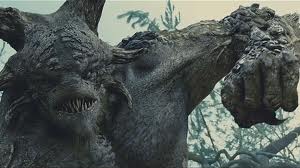
Wonderful fairy tale troll!
 Fairy tales are part of the dark mythological underbelly of civilisation, and many lessons and social commentaries exist today in these handed down tales. In like fashion, many books are simply repeats of or expansions upon eternal themes such as the quest/journey/coming of age etc. Anne R. Allen says: Experts don’t agree on the exact number of narrative plots, but there aren’t many. (Good post in case you think someone like James Patterson stole your plot!)


So how can we look at this film and learn some writing lessons?

Let’s check out the reviews. These comments (I've underlined the most telling) can be applied to writing.

Rotten Tomatoes: While it offers an appropriately dark take on the fairy tale that inspired it, Snow White and the Huntsman is undone by uneven acting, problematic pacing, and a confused script.

The Washington Post: Michael O’Sullivan says: Too many bad apples spoil a tale. Overlong, overcrowded, overstimulating and with an over-the-top performance by Charlize Theron as the evil queen Ravenna, the movie is a virtual orchard of toxic excess, starting with the unnecessarily sprawling cast of characters. Snow White and the Huntsman feels less like a movie than a deadly cocktail of movie clichés, all of which have been thrown into a blender, set to ‘slow’ and pureed for two hours.

The San Francisco Chronicle: “…which takes everything mythic about ‘Snow White’ and pounds it out until it's flat and dead. It takes something whose truth is elusive and turns it into a movie that's obvious and trivial. The fairy tale … suffers from a problem in its rhythm. It's not that its pace is too slow, but that it's too regular, and this lack of syncopation makes it feel slow.

Ouch!

A Writer’s Digest article advises: Analyze successful stories. They (writers) ask questions when reading and use their findings to help strengthen their work. For example:

• How does the writer make me want to turn the page?
• Why am I drawn to the lead character?
• When are the stakes raised?
• How does the writer integrate minor characters?
• What makes a scene work?
• What’s the key to conflict?
• How does the writer handle dialogue?

In my humble opinion, the problem with Snow White is that loads of bad stuff eclipsed loads of good stuff. A cleaner, simpler story, tighter pacing, consistent characterization, believable motivation, a good sub-text and backstory, and quicker links to the actually great action scenes would have transformed this film into a iconic version of a tried and tested tale of good triumphing over evil. People don’t get tired of a good story told well.

How well are you telling your story?

Thursday, June 14, 2012

Beware the Expert Reader!


Convincing the Expert Reader is hard, because whatever you write, there's always an expert reader waiting to pounce. But expert readers are good for writers. Yes, they really are because when you write with an expert reader in mind, you get your facts straight.

In many movies and books, some of the characters do the most uncharacteristic (or plain dumb) things. (See my previous post discussing the movie Prometheus) I hate it when something a character says or does just sounds wrong, or else I know it cannot be done. I happened upon a great article by John Yeoman of Writer’s Village: How can you make your characters’ actions appear plausible?

Many a good story has collapsed because a character did something that just didn't ring true.


Tom Hanks looks exhausted!
The plot of The Da Vinci Code, absurd enough from the start, topples into farce about halfway through the story. Why? All the action—spanning 180,000 words—is supposed to take place within the space of just 24 hours. Yet in that brief time the characters have run, flown and driven halfway across Europe and England.

Nobody ever sleeps! (Have you noticed?) By chapter 105, Prof Langdon is still making brilliant deductions, having been awake for 30 hours. Somehow, it doesn't 'ring true'...

Beware the expert reader

Every story has an expert reader who will embarrassingly point out that, for example, your 25 stone villain just could not have wriggled down a 15-inch wide manhole in a New York street, circa 1920, while disguised in a fire-fighter's uniform. But if you get even the tiny details right, that expert reader—highly impressed—will buy everything you write thereafter. And your story will also convey the 'ring of truth' to everyone else.

Q: How do you enhance your story with a 'ring of truth', effortlessly?
A: Make your story plausible and your characters 'real'

Helpful Hint: If you want your character to do something unusual, do it yourself.

Otherwise, you will never be able to convey—convincingly—how the experience looks, feels, hears, smells, or tastes to the character. True, you might not wish, personally, to flee a drug-crazed axman or abseil one-handed down the Burj Khalifa tower in Dubai. But if it’s do-able, do it.

When I wanted my character to rescue a heron snarled high in an ancient elm, I scaled my plum tree. After ten feet, my hair was thick with dust, leaves, and insects. (I had never realised how dusty tree bark can become in dry weather.) My trousers grew green with mould and I became massively perforated like St Bartholomew with little twigs. Of course, I then got stuck. (Branches are never as close to hand in real life as they are in fiction.) My wife had to rescue me with the window cleaner's ladder.

On another occasion, I needed a thief to climb an old staircase with a lantern in his hand. So I did exactly that. I found it was necessary to step on the inside of the stairwell to avoid telltale creaking noises and to breathe very slowly (ditto). I also had to tread on the balls of my feet (ditto) and to balance myself on the banister by my left elbow. (I didn’t want to leave tell-tale finger marks.)

Have you ever dragged yourself across an attic floor, gibbering? In a different tale, I decided to have my protagonist explore the eaves of an old castle in search of dark family secrets. Luckily, I live in an old house. So I dragged myself across a blanket of 18th century dust. My knee went through one of the ceiling planks. Below it, I found an orange—perhaps the lunch of some bygone builder. The orange was entirely hollow. Its inside had withered away to leave only a perfect mummified shell. It nicely symbolised my fictional family—immaculate before the gaze of the world but rotten within.

You can't make these details up. You have to discover them.

So if a detective finds the full mark of a flat foot on a dusty stair, I realized, it had probably been put there for a deceptive purpose. Because people typically climb stairs on the balls of their feet. All these little points of observation found their way into my story.

When historical novelist Elizabeth Chadwick sets her stories in medieval castles, she visits them—with camera, notebook, and tape measure in hand. If she tells you that her hero in 1395 wriggled out of a kitchen window of Ludlow Castle that was exactly 15 inches wide, 16 feet above the courtyard and ten paces from the main gate, you can trust her. She’s measured it.

Climb that castle wall first!

That’s one reason she has a loyal readership. Apparently, some readers make a point of visiting the locations of her novels, just to check her measurements!

Don’t imagine it. Do it. Walk your story, as far as sanity permits. And readers will then believe you and your story.

So there you have it, dear writers (and readers). Never guess how long/high/light/far/heavy etc. something is. Do it yourself! Run from the Louvre to the Opera House (The Da Vinci Code), climb that mediaeval castle wall if possible, shimmy up that tree and really try to rescue the cat (Trust me, they don’t cooperate).

For more excellent tips, sign up for John’s newsletter and get the latest on writing courses.


Tuesday, June 12, 2012

What Writers Can Learn From Prometheus!


So, what can writers learn from Prometheus?


I just watched the new Ridley Scott film Prometheus. Is it good? It’s great. But is it good? No, not really, if you’re interested in the story, the fact that it’s the prequel to the wildly successful Alien franchise, and if you’re a stickler for tying up loose ends. If you’re the kind of person who doesn’t mind threads not being carefully tied up by the end of a film or book, then don’t panic. Sometimes it’s good just to go along for the ride. But if you’re the pernickety kind of person that all writers should be, then pay attention.

Story: Set in the late 21st century, the story centres on the crew of the spaceship Prometheus as they follow a star map discovered among the remnants of several ancient Earth cultures. Led to a distant world and an advanced civilization, the crew seeks the origins of humanity, but instead discovers a threat that could cause the extinction of the human race.


Prometheus
 Now read this Forbes review, which posed many of the questions I asked myself as I walked out the theatre. How, why, when, why not, no, really, you can’t be serious, oh, please! – all the questions/comments readers/viewers should never have to ask at the end of a book/movie.

So, the lesson writers can learn from Prometheus is this: keep a tight hold on your story. Grab it by the tail and don’t let it go, not for a second.


Fatal Flaw #1: Unanswered Questions

Helpful Hint: Answer every question and tie up every thread by the end of your book. A nifty way of doing this is to make a synopsis of each chapter once you have written it. Then when you have finished your manuscript, and the accompanying synopsis for each chapter, read the manuscript backwards (yep, backwards) and check if you have answered every single question that an alert reader might raise. How did Character A get the amazing artifact? How or why did Character B get motivated to do whatever? Is the secret everyone’s been trying to discover actually worth all the trouble people took to conceal it? As you edit your own work, ask the questions as each character confronts them, and then write them down. By the end of your book, go back, read the questions, and answer them. If you can’t, then your reader can’t.

Fatal Flaw #2: Characters Doing Uncharacteristic Things

Helpful Hint: This was a big problem for me in the movie and so much so that the characters’ sometimes-idiotic behaviour actually diminished their authenticity for me. You’re asking readers (or in this case, moviegoers) to suspend their disbelief and join you in an incredible story that will move/excite/anger/do whatever to engage their emotions. So, make sure your characters behave like real people and that they don’t do things that are uncharacteristic just because you have to make your story move along.

Did I like the movie? I LOVED it, until I started asking myself all these niggling questions. But, I still loved it. I'll probably buy the DVD.