Showing posts with label mythology. Show all posts

Tuesday, May 10, 2016

Book Review: Dragons Are Real


Dragons Are Real, written by Valarie Budayr and illustrated by Michael Welply, is a must-have for dragon aficionados the world over. Inside this amazing book is a grand revelation: dragons ARE real. Much maligned over the centuries through myth and legend (and made up stories!), the dragon is not the tyrannical, fire-breathing monster who kidnaps damsels in distress and gobbles them up with mustard and ketchup. No, the true dragon is a humble, gentle friend to all, with amazing qualities that would make anyone want to be his comrade for life.

 They love to laugh, so you can always give them a good tickle, and they particularly enjoy riddles. The author offers a unique riddle inside the book, one that is guaranteed to secure your lifelong friendship with a dragon. They love reading and (contrary to popular opinion held usually by banks and kings in their counting houses) the dragon prefers to hoard books, rather than gold treasure. You see? A very different picture of the dragon begins to emerge. They love to dance and have fun. Masters of disguise, they can become anything you want, for example if you feel like rolling down a lush green hillside, just for fun. The dragon is an amazing and incredible creature and this book reveals the true nature and excellent qualities of dragons.
This is an absolutely beautiful book. I received a pdf copy and would have loved a print copy because the design and illustrations are just outstanding. This is a book for children to keep, to linger over and treasure, not only for the amazing images, but because the detail within each page keeps the reader there. The dragons’ expressions, the fine detail, the very ‘aliveness’ of each illustration had me spellbound. I loved the dragon being a master of disguise, and particularly appreciated the intricacies of the dragon’s study, filled with books, and with a tiny resident mouse also engrossed in a miniature volume.

I cannot praise this book more highly and I feel really privileged to have read it. I wish it could be animated, so as to enjoy these amazing dragons and the beautiful details even more. Congratulations to the author and illustrator for a work of art. I spent time on each page and I’d encourage parents to do the same when reading this with their kids. An excellent message, besides all the lovely ones about the good and noble qualities of dragons, is that reading is something to bring enjoyment; it’s a doorway to a magical world, as this stunning book amply proves.

Thursday, October 1, 2015

The Mystery of Dragons!


Who doesn’t love dragons? When I was writing The Search for the Stone of Excalibur, I was determined to find a place for dragons, or at the very least, a book about dragons. I managed to fit one in, actually a book not just about dragons, but a bestiary, which is a book about various animals and mythical creatures, and something that was very popular in the Middle Ages.

Artist's impression of Excalibur
Stories of dragons appear all throughout history and almost every culture has their own idea about dragons. Some reasons for this could be the finding of dinosaur fossils. Dragons could be used to describe the bones of gigantic unknown creatures. Adam is disappointed at first when he hears a description of the ‘serpents’ on Excalibur, Arthur’s sword, because they don’t seem to resemble the creatures he saw on the hilt of the ancient sword in the Ashmolean Museum. However, he then finds out that in fact… Then Archie said, ‘Of course, the serpent and the dragon were intertwined in Celtic mythology, the dragon being in essence a large serpent with legs and wings.’”


In Celtic mythology, the dragon was believed to inhabit a world that was parallel to the physical world. Druids believed that the dragon’s power affected the ‘ley’ or energy of the land. They believed that the path the dragons took, called a ‘vein,’ was important to the flow of energy through the physical world. Where dragons trod, magical power flowed, and where they laired were invariably places of great sanctity and mystical harmony. Areas where a dragon passed often, where dragon paths crossed, or places a dragon stopped to rest became more powerful than the areas surrounding it. Druids hunted for these lines and made ley lines maps for their people, instructing them to build their temples and homes along the lines in order to harvest the energies. Stonehenge is thought to be one of those places. In addition, some believe that the Celtic cross surrounded by a circle is a symbol of the crossing ley lines and the circle of life is centered on that power.

King Arthur himself was burdened by dreams of dragons; although it is unclear which color he saw. He saw them specifically at the time of Mordred’s conception and before his death. He is eaten by dragons in his final dream and it is at his next battle that Mordred kills him. It is said that when a king sees dragons then ruin will come to his kingdom and himself.

There are two types of dragons in Celtic lore. There is the standard winged version with four legs that most people are familiar with and there is a sea serpent that is depicted as either a giant wingless serpent or a huge serpent with wings, but no legs. The dragon was a gatekeeper to other worlds and guardian to the secrets and treasures of the universe. They were often depicted side by side with the Celtic gods. As creatures that protect the Earth and all living things, Celtic dragons are considered the most powerful of all the Celtic symbols.


Dragons are used as a symbol of power and wisdom among leaders. Dragons are seen on many coats of arms. The Welsh flag proudly displays the Red Dragon and their motto reads: Y Ddraig Goch Ddyry Cychwyn, meaning ‘The Red Dragon Leads the Way.’ Y Ddraig Goch, the red dragon, was derived from the Great Red Serpent that had represented the Welsh god Dewi.

As a heraldic symbol, the dragon varies greatly, especially the ears. The wings are always that of a bat, and its tongue and tail can be barbed or smooth. King Arthur was one of the first leaders to use the red dragon. It was prominently shown on his helmet. Dragons are often depicted in Celtic artwork, many times drawn with their tails in their mouths. This symbolizes the cycle of nature in the world and immortality. The dragon is usually twisted upon itself, with tail, ears, and body parts weaving in and out of other parts, much like a regular knot work piece.

If you’re looking for more adventures, then please visit The Quest Books, where Middle Grade authors Cheryl Carpinello, Wendy Leighton-Porter and I have teamed up to offer readers an array of exciting quests. Sign up for our monthly newsletter with exciting exclusive material and get your choice of any e-book on the site FREE!

Tuesday, October 14, 2014

The Search for the Stone of Excalibur


I am proud to announce that Book 2 in The Chronicles of the Stone is now available on Amazon. The Search for the Stone of Excalibur grew from Book One, The Secret of the Sacred Scarab. I am a huge King Arthur fan and having travelled all over Scotland, visiting castles, I decided that Britain would be the location of the boys’ quest for the Second Stone of Power. The legends and stories about King Arthur and Excalibur are the perfect vehicle for this book. There is so much magic and mystery surrounding this historical figure that I had enough material to craft a fascinating adventure. If you love history, geography, action, adventure, archaeology and a story that grips you from page one (plus lots of danger!) then this is the book for you. This will also appeal to anyone who wants to save the world or (for those readers a little older) remembers their plans to do so!

Book Synopsis: Continuing the adventure that began in Egypt a few months prior in The Secret of the Sacred Scarab, cousins Adam and Justin Sinclair are hot on the trail of the second Stone of Power, one of seven ancient stones lost centuries ago. This stone might be embedded in the hilt of a newly discovered sword that archaeologists believe belonged to King Arthur: Excalibur. What gave Excalibur its incredible powers, so great that even historians have recorded its singular abilities? Could it be that a Stone of Power is embedded in the hilt?

However, their long-standing enemy, Dr. Khalid, is following them as their travels take them from Oxford, England, to Scotland, where the location of the quest is in an old castle, a ruined chapel, and with a few ghosts thrown in as well. Little do they know there is another deadly force, the Eaters of Poison, who have their own mission to complete. Who are these enigmatic and scary Eaters of Poison, driven by an ancient purpose? What is their connection to the castle's past and James’ ancestor, Bedwyr the Curious Monk, whose research into history started all the trouble? Time is running out as the confluence of the planets draws closer. Can Justin and Adam find the second Stone of Power and survive? And why did Aunt Isabel send a girl with them?

Join Justin and Adam as they search not only for the second Stone of Power, but also for the Scroll of the Ancients, a mysterious document that holds important clues to the Seven Stones of Power. Right from the start, this adventure is not like the first. As their new adventure unfolds, they learn many things and face dangers that make even their perils in Egypt look tame. And how annoying for them that their tag-along companion, Kim, seems to have such good ideas when they are stumped.

I’d love book reviews and am very happy to supply e-pub or Kindle version for anyone keen to read and review the book. Please email me at Fiona@fionaingram.com.

Sunday, March 2, 2014

Book Review: Only the Dead


In Only the Dead, author Hamilton Wende brings together his journalistic experience of covering war-torn zones, and his interest and research into ancient mythology in a compelling tale. The story has a number of threads running through it to create a fascinating tapestry. Again, as in his previous book House of War, Sebastian Burke reappears; this time he is invited to assist psychologist Tania Burke as she tries to help children traumatised by a war in Uganda, a terrifying army of children led by the megalomaniac General Faustin, assisted by his mysterious shaman figure, Papa Mephisto, and his blood-seeking machete Chonge. If this sounds like a weird mix, it is not. Child armies are a sad truth of Africa and the tragedy of these children ripped from their homes, forced to fight, brainwashed into mindless violence by a mesmerising and charismatic leader who fulfils the role of father figure in their lives is all too familiar to readers who have some idea of politics and war in Africa. Papa Mephisto introduces his benefactor General Faustin to the mysterious lion cult, claiming powers that would make the general and his young army invincible. Sebastian Burke’s interest in lion mythology weaves into this dark, tangled web of atavistic beliefs and fears. At the same time, Islamic terrorist activities and the American interest in protecting the USA and the world from a nuclear threat also underpins this tragic scenario.

Despite the horror of this bleak wasteland of the soul, faint glimmers of hope appear, namely in the main character of one of the child-soldiers, Okuto. He has suffered the same fate as his fellow soldiers, his parents perhaps killed, his village burned. Scarred emotionally and physically by his experiences, only the general and Papa Mephisto mean anything to him. That is, until Victoria, a fellow conscript makes an impact in his life. His love for Victoria is the only thing, ultimately, that has any meaning, and it is his redemption. Between these threads the reader will also learn about the Islamic terrorist, whose love for his daughter, killed accidently by a US drone attack meant for him, drives him to perpetrate a horrific vengeance. A sad but necessary character is the man who pushed the button, a man we don’t really get to know, but his tragic story resonates throughout the book. Love, loss of love, and redemption form a strong element here, and one that lifts the book out of a dark resignation. War is an inevitable part of human society, and the collateral damage is also inescapable. The pace of the book drives the reader on to keep turning pages. The author also intersperses references to the lion culture and myths and legend throughout in little tantalising snippets. There are subtle references that the keen-eyed reader will pick up and not so subtle ones, such as the story of Faust (General Faustin) and his pact with the devil (Papa Mephisto). The conclusion is open-ended, and one wonders if there will be more books. A great read from a talented author who manages to draw you into the hearts and souls of both the characters and the land they inhabit. Five Stars!

Saturday, December 28, 2013

Zoe and Zak and the Yogi's Curse Blog Tour

Yogi's Curse Blog Tour Banner

About the Book

Title: Zoe & Zak and the Yogi's Curse (Zoe & Zak Series, Book #2)
Author: Lars Guignard
Publishers: Fantastic Press
Publication Date: September 9, 2013
Pages: 340
Recommended Age: 8+

Summary

Zoe and Zak are back in India. Again. And this time they're attending Moonstock Himalayan Boarding School, which might seem fun except for the fact that the school itself is a little strange. Students ride elephants instead of school buses, snarling monkeys work as security guards, and angry parrots monitor the halls. And even when they manage to get used to the wildlife, the food is absolutely terrible. But living with a bunch of other kids their age can be a lot of fun, too, or at least it seems that way until Zoe's roommate goes missing. Following the directions written on a steamy bathroom mirror, Zoe and Zak fly through the clouds on their magic carpet to learn that the two of them have been chosen yet again. This time they've been asked to lift the Yogi's Curse. It's not going to be easy. Zoe and Zak don't even know what the Yogi's Curse is let alone how to lift it, but like it or not, they soon discover that a whole lot of people are depending on them. Now, if they're going to save the day, Zoe and Zak are going to have to fool the monkey guards, avoid the nasty parrots, and maybe even develop a supernatural ability or two. Because lurking beneath Moonstock is a powerful new enemy. And if Zoe and Zak can't stop him, nobody can.

My review:  Moonstock Himalayan Academy for Boys and Girls might sound fun except for the fact that this is no Hogwarts in the Himalayas, where with the wave of a wand one can conjure up delicious feasts and fun stuff. For one thing, the food is terrible, toilet paper must be purchased, the hot water is erratic, there’s no technology (like Internet) and the teachers are eccentric bordering on weird. Anyone who ever attended boarding school will remember how often reality diverged from the brochure. But attending the school might just be more important than the kids think; after all, Moonstock has the reputation for turning out achievers and those who go on to change the world in some way. The crazy part of Moonstock becomes apparent when, adding to the weirdness, Zoe’s roommate Anita goes missing on the first day. Zoe and Zak learn that they have been chosen yet again for an important mission. This time they’ve been asked to lift the Yogi’s Curse and a whole lot of people are depending on them. To make matters worse and just when they need all the extra help they can get, Zak’s whip Stryker (which turns into a two-headed cobra) and the magic carpet (masquerading as a humble Doormat to escape detection) are confiscated by the school owners as ‘prohibited items.’ The tension mounts as the kids are pursued by giant fire-winged birds with malicious intentions, a talking elephant informs them that elephants are on the brink of death unless the curse is lifted, and they have a formidable demon enemy to defeat. Can Zoe and Zak save the day?

I really enjoyed this read. For me, the second book has cemented the series and made a lovely springboard for Book 3. Zak and Zoe’s success in the first book created a domino effect of events that take them into this adventure. Back story keeps new readers attuned so both plots link up nicely. Zak really comes into his own here and takes the word ‘intrepid’ to new heights. He stares down Amanda Mean, the school bully; goes into partnership with another student running an informal tuck-shop (that stocks lots of decent toilet paper); starts a vlog; and has some really inventive ideas using whatever comes to hand (including a flying feather!). He may not have Zoe’s powers, but he makes some surprising decisions that work out just fine. Zoe stops being so self-pitying and starts to think about just why her mother chose Moonstock as a boarding school. The action is non-stop and plot twists and turns keep readers hanging onto their magic carpets as they fly along with our heroes. The magicality is wonderful, using legends and fantasy elements from Indian culture and mythology. There are no instant spells ‘imported’ into the story: all the enchantment belongs firmly in India, using cultural and folkloric aspects that will no doubt get young readers interested in reading up more about the background. I thought the constant reference to ghastly food making the students sick, and the chemistry teacher’s unfortunate tendency to flatulence a bit repetitive, but no doubt kids will just crack up laughing each time they read it, so this is a minor issue. Zoe narrates, as in Book 1, and the lovely dry humor in her comments will appeal to adults as well as kids. The ending wraps up nicely with both Zoe and Zak having grown and matured, and learned some important life lessons. I really am looking forward to reading Book 3. Five Stars

Purchase

Yogi's Curse by Lars Guignard

Amazon (Print) | Amazon (Kindle) | Amazon (Audiobook) | iTunes (Audiobook)


The Buzz

"I have a 10 year old son who is an avid reader!! He loves books, (but he's picky too) he loved Harry Potter and Percy Jackson. He was so excited to read the 2nd book in this series! When I presented him the first book he was not sure he would like it but changed his mind quickly, then when I heard about the 2nd book being released he almost jumped out of his chair! (no exaggeration) He is anxiously awaiting the 3rd book! I would say that any child who enjoys fantasy/adventure books should read this series! It is a well written page turner! It's a fun story that adults can even enjoy the storyline without getting bored! According to my son, 'every kid should read this series'. " ~ 5-Star review from SavyGreenSaver, Amazon
"I loved this book, even as an adult reading it. I was completely sucked into the plot and was constantly finding myself staying up "just a little longer" to read one more chapter. Different twists and turns in the book have you constantly guessing who is behind what and who Zak and Zoe can trust. I could definitely see myself being involved in this series as a middle schooler considering how much I enjoyed it even now. Another thing I liked about it is if you missed the first book, you could still follow along with this one and not be lost." ~ 5-Star review from Staci, Amazon
"Lars Guignard has done a fabulous job with this series. I loved the `Ghost Leopard' & love this one even more. For late-elementary to middle school age readers, you can't beat this series. It's fun and fast-paced. Even my picky fifth grader enjoyed every page. There are bits of magic thrown in keep the action exciting. Mr. Guignard has a brilliant imagination & readers are blessed that he's chosen to use it for YA fiction. If you've yet to read the first installment in this series, do yourself a favor and read these books back to back. Don't limit it just to kids! Adults will have a blast reading these too!" ~ 5-Star review from Liz Terek, Amazon
 

About The Author: Lars Guignard

Lars Guignard Prior to writing novels, Lars Guignard wrote for film and television. As a teenager he attended boarding school in the Indian Himalayas and his experiences there provided the inspiration for the Zoe and Zak series which now include: Zoe & Zak and the Ghost Leopard, Zoe & Zak and the Yogi’s Curse, and Zoe & Zak and the Tiger Temple. He lives in the Pacific Northwest where he dodges bears and cougars while hiking & skiing the magnificent Coast Mountain Range. For news about new releases, please join his email list here: Zoe&ZakAdventures@gmail.com

Blog | Twitter | Facebook | Goodreads


The Yogi's Curse Blog Tour Schedule (2013/2014)

December 15
December 16
December 17
December 18
December 19
December 20
December 22
December 24
December 26
December 29
December 30
December 31
January 2
January 3
January 5
January 6
January 7
January 8
January 9
January 10
January 11
January 13
January 14
 

** Be sure to look for the upcoming Blog Tour for Book 3 in the Zoe and Zak Series, "Tiger Temple" coming January 15, 2014. **

  MDBR Kid Lit Book Promotion Services - Button FINAL

Wednesday, September 18, 2013

Q and A With Cheryl Carpinello


As part of the Young Knights of the Round Table Blog Tour, I get to ask author Cheryl Carpinello all the questions one usually likes to ask and author: the how/what/when/where. Cheryl has very kindly agreed to spill the beans. So glad to have you visit my blog today, Cheryl and here come the questions.

1. When did your fascination with all things Arthurian begin?

My real interest began in college in my English Lit classes. I fell in love with Beowulf and the early English tales and ballads. We read Sir Gawain and the Green Knight, which I liked, but when we read Morte d’Arthur by Malory, I was thoroughly hooked. I love Malory’s description of the pageantry and tournaments, the knights and the court. By the time I read Tennyson’s  The Idylls of the King, there was no stopping me. I started reading whatever I could find, fiction and non-fiction. This carried over into my high school classroom where I taught the King Arthur Legend for over 20 years.

 2. What was your favourite Arthurian book as a child?

I’m a bit embarrassed to say that it wasn’t a book; it was Disney’s animated movie The Sword in the Stone! The movie was my first introduction to the King Arthur Legend. It presented an innocent look at a harsh time.
 
3. What is your favourite Arthurian book as an adult?

That would easily be T. H. White’s The Once and Future King. I’m a romantic, and I love the philosophy of Hope that White displays throughout the book. It’s heartfelt, humorous, thought-provoking, and brutally honest in places, and leaves me energized each time I read it. I’ve read it over ten times in the last 25 years.

 4. I love the research and many wonderful details you put into your books: where do you find these?

 Boy, that’s hard to say. I’ve always had an incredible memory for details. Over the hundreds of books I read relating to Arthur, coupled with my years of teaching a variety of Arthurian literature, some pieces just stick in my brain. The descriptions of feasts and standards in both of my books probably comes from Malory’s influence. Somewhere in my reading I remember coming across a passage that described Camelot as sitting in a high pass, so I used that in Guinevere. I did extensive research on Pembroke Castle, Cardigan Bay, and that part of Wales for Young Knights. In fact, I used The Lonely Planet’s Guide to Wales. Guide books contain lots of gems that textbooks leave out.

5. Young Knights is a truly wonderful tale. At the end of the book, I wished it had been longer because I could see where things could have been developed. Was it always your intention to write a novella?

Yes, it was. I write my Arthurian Tales for a specific audience: reluctant readers. That doesn’t mean I don’t want others to read them because I do. But those readers who can read, but choose to do other things are who I am trying to reach. Their attention span is shorter. Printed page after printed page turns them away, hence in my printed books (and in Guinevere’s eBook) each chapter starts with a picture related to the chapter. I’m a believer in encouraging kids to develop their imagination in a world where every detail is vividly laid out especially in the movies and video games that kids love. I want them to think about what might have happened, or if something else could have happened.

6. And will you be taking the adventures of Bryan, Gavin, and Philip further?

 Definitely. Future installments will probably focus on just one of the three characters at a time. That is kind of set up in the end of Young Knights. It’s also possible that readers may see some new young knights at some point.

 7. How has the reception been towards Young Knights? Are many of your readers actually adults reliving the Arthurian adventures of their youth?

Young Knights has done well since its debut in May 2012. The Children’s Literary Classics gave it their Seal of Approval as a Recommended Read and awarded it a 2012 Silver Medal for YA Fiction. Also in 2012, Young Knights was a finalist in USA’s Best Book Awards for e-Book Children. In 2013, Young Knights received an EVVY Merit Award for Juvenile/YA Fiction from the Colorado
Independent Publishers Association. The cover was also a 2013 Ariana Finalist. From the reviews I’ve read, many adult readers are enjoying the story of the Young Knights. I’ve found in this genre, that people who love Arthurian Legend eagerly devour all books that come their way. It’s nice to see that a Legend so old, still draws people to its stories.

 8. What is the best Arthurian movie ever made, in your opinion?

 I haven’t seen many of the movies out there, and my tastes are a bit eclectic. I’ve always liked First Knight. Most people don’t, but I’m a huge fan of Sean Connery. I also like the courage of Guinevere in that movie. Probably my favorite is one called The Last Legion. It tells the story of Ambrosius/Merlin leading the boy Romulus Augustus out of a defeated Rome and to the isle of Britain. Romulus carries his father’s sword Excalibur. It’s a different look at the legend.

9. Why do kids love stories of knights, quests, adventures, etc. so much? It’s amazing that in Young Knights, the young heroes are immersed (as are readers) in another world. There are no dystopian/apocalyptic scenes, and no whizz-bang SFX - just an historical adventure. What is this enduring appeal?

 Do you have a couple of days?! I can give you my ideas based on what I’ve observed in my classroom and in my workshops with kids.

 Heroes: The Legend is full of heroes not just King Arthur. Every kid wants to be a hero if only to them. Heroes live by certain standards and are not always strong, but they don’t give up or lose hope. Arthurian Legend teaches the boundaries of right and wrong, the limits placed on people’s actions, and the consequences for crossing those boundaries or exceeding those limits. Young people hunger for those examples. Kids also see how the ideals of Arthurian Legend are present in the world today and that leaves an impression on them.

 Adventure: The Legend is packed with adventure, and every kid loves adventure, even the most introverted. And what could be more adventurous that riding into battle to save the castle or the princess and going on quests for fabulous historical objects?

 Magic and Mystery: The Legend holds infinite magic and tons of mysteries. In fact, the greatest magician of all time lives in Arthurian Legend: Merlyn!

 I’m not sure if this answers your question, Fiona, but when all of the above are packed into a book, it is one heck of a story that kids devour.

 10. I just adored Guinevere when I first read it. Straying off the Young Knights briefly, will we
see more of Guinevere when she actually marries King Arthur?

 No, but you will see more of Guinevere before her marriage to Arthur. While she grew up quite a bit in On the Eve of Legend, Guinevere still has more growing to do. I’m planning on another book which focuses on her growth and also has young Cedwyn taking a bigger role in the action.

 11. If you had a time machine and could go back to King Arthur’s time and be someone at his court for a week -- who would you be?

 I’d choose either to be a squire to one of Arthur’s knights or a Lady-in-Waiting to Guinevere. Those positions would allow me to get a better view of life in Arthur’s court. As a squire, I would be able to experience what a knight’s job consisted of and how the knights actually trained. As a Lady-in-Waiting to Guinevere, I would be privy to her thoughts and would come away with a better understanding of her.

 12. Is there anything you’d like readers to know that I haven’t asked?

Yes. Readers may not know that The Young Knights of the Round Table comes with a free 18-page Teacher’s Guide with additional information on items in the story, activities, and a study guide. It is available at the time of purchase from my publisher MuseItUp Publishing, or readers may send me a message through FB, Twitter, or my website Beyond Today Educator.

Also, the Wise Owl Factory developed a free Teaching Supplement with Student Pages courtesy of the talented Carolyn Wilhelm for the book. For the time being, that can be downloaded from the site. As soon as I can take up the battle with my website, I’ll upload the Supplement there for readers.

13. You are offered a choice between Merlin’s wand and Arthur’s sword Excalibur: which one would you use in battle?

Both are appealing. Excalibur would severely test my physical strength, and if the stories are true, I’m not sure I would be able to wield it! Merlin’s wand, on the other hand, is an instrument of the mind. One does not use it recklessly! I would choose Merlin’s wand. What a feat it would be to not only learn the spells, but also to understand when to use each one.
 
For readers who (understandably) want more, take a peek at what went into making the award-winning MG novella Young Knights of the Round Table: The King’s Ransom. Behind the Scenes of The King’s Ransom (Book 1 of The Young Knights of the Round Table) will add to your Arthurian experience. Meet the Young Knights and then take a virtual tour of Wales with them. Get up close and personal with author Cheryl Carpinello. Read Dunham’s Story, an exclusive not found anywhere else! Read excerpts from The King’s Ransom and Guinevere: On the Eve of Legend.
 
By Fiona Ingram
 

Wednesday, July 31, 2013

Book Review: The Shadow of the Minotaur


The adventures of twins Jemima and Joe, their talking Tonkinese cat Max, and their best friend Charlie continue with another trip back into the past using the magic book they found in their uncle’s attic. Their previous adventures began with a time travel trip to Atlantis in search of their parents, who have mysteriously disappeared. The book, Shadows of the Past, (which belonged to their missing parents) opens to the second chapter, and the poem (a clue) that begins the chapter indicates the adventure concerns the Minotaur and the Athenian prince Theseus. They unhesitatingly step into the past, and find themselves embroiled in an adventure that’s a lot more dangerous than the previous one. Theseus is rather a selfish, absent-minded hero, and without the kids’ and Max’s good ideas, will he even manage to slay the Minotaur at all? With the help of Princess Ariadne (King Minos’ daughter) and of course Max’s vital intervention, they need to achieve their mission and make it back to the present day.

 Having read The Shadow of Atlantis, I confess I couldn’t wait to go on another time travel trip with this trio (or should that be quartet?). Author Wendy Leighton-Porter has an amazing knack of placing her heroes right smack into situations that are potentially big and scary (and this one is uber-scary) and then letting them work out the escape routes by using their brains. The kids are refreshingly honest. They don’t let arrogant Theseus steal all the glory. They are also very brave and inventive. They reaffirm the bonds of friendship and loyalty, and isn’t that what kids should be learning in life lessons. It’s not easy to do the right thing when situations are frightening and dangerous, but our young heroes, human and feline, persevere against all odds. The adventures will continue as the kids search for the twins’ parents, but their renewed hope brings a new and positive slant to their escapades. This is a fantastic way of getting young readers interested in ancient myths and legends, and in realising that history is not dry as dust, but is vibrant and exciting. All the characters are believable and wonderfully drawn. Max, of course, quite steals the limelight! Find The Shadow of the Minotaur on Amazon. Five Stars!
 

Wednesday, January 30, 2013

When I Judge a Book by its Cover...


When I judge a book by its cover, it means I want to show off a fabulous new book with a beautiful cover, in my huge sets of bookcases that dominate my living room. I love real books. I won’t say I hate e-books, but I’ll only buy an e-reader when no more real books are printed. Given the number of people who also love real books, maybe we can stave off that awful day. I wonder if many people know this, but when you buy a real book and take it home to gloat over, it’s actually yours for keeps. When you buy an e-book, you’re actually only buying the right to read it… But, hey, let’s not go into all that. Let’s stick to real books.

This post was inspired by my annual attendance at the Exclusive Book’s annual sale. (Exclusive Books is South Africa’s leading bookstore and cleverly align themselves with a coffee shop to add extra comfort to book-lover browsing) People love the sale because all the books are marked down, and it’s one way of stocking up on expensive items that might just break the budget. So, what did I buy this year? Aha! I generally pick non-fiction because they are usually hard cover. I also tend to read a lot of non-fiction for research into my children’s adventure series, and because I like history.
The Secret History of Giants by Ari Berk

I know giants are not strictly non-fiction, but ever since a light-fingered somebody walked off with my Book of Giants (no longer in print), I have wanted a replacement. I mean, what is a home without a book on giants? I already have Brian Froud’s Faeries and The Book of Good and Bad Faeries, so definitely a giant replacement was on the cards. This is what the blurb says: Ancient Greece had its Titans, the Celts their Green Knight, the Bible Goliath—and for those who know where to look, signs of these legendary hulking creatures still abound. Now comes a hugely engrossing chronicle of giants since antiquity, from their role in forming mountains and causing earthquakes to the mysteries of their sacks (watch out for hitchhiking humans); from their means of employment (how did the Druids built Stonehenge?) to an extensive map of places around the world where giants may likely be found. Exhaustive and lushly illustrated, this enormously valuable resource is sure to fascinate all who open its covers.

Special features include: sundry flaps, booklets, and gatefolds; a lavish foiled and embossed cover (and it is lavish!); an elegant tassel (very elegant!) dangling from the spine.

Babylon: Mesopotamia and the Birth of Civilization by Paul Kriwaczek

Civilization was born eight thousand years ago, between the floodplains of the Tigris and Euphrates rivers, when migrants from the surrounding mountains and deserts began to create increasingly sophisticated urban societies. In the cities that they built, half of human history took place. In Babylon, Paul Kriwaczek tells the story of Mesopotamia from the earliest settlements seven thousand years ago to the eclipse of Babylon in the sixth century BCE. Bringing the people of this land to life in vibrant detail, the author chronicles the rise and fall of power during this period and explores the political and social systems, as well as the technical and cultural innovations, which made this land extraordinary. At the heart of this book is the story of Babylon, which rose to prominence under the Amorite king Hammurabi from about 1800 BCE. Even as Babylon’s fortunes waxed and waned, it never lost its allure as the ancient world’s greatest city. Engaging and compelling, Babylon reveals the splendor of the ancient world that laid the foundation for civilization itself. (I can’t wait to get stuck into this!)
 House of Wisdom by Jonathan Lyons

Although I see this book received mixed reviews on Amazon, I’m willing to give it a chance. The blurb says: For centuries following the fall of Rome, Western Europe was a benighted backwater, a world of subsistence farming, minimal literacy, and violent conflict. Meanwhile Arab culture was thriving, dazzling those Europeans fortunate enough to visit cities like Baghdad or Antioch. There, philosophers, mathematicians, and astronomers were steadily advancing the frontiers of knowledge, as well as keeping alive the works of Plato and Aristotle. When the best libraries in Europe held several dozen books, Baghdad's great library, The House of Wisdom, housed four hundred thousand. Jonathan Lyons shows just how much "Western" ideas owe to the Golden Age of Arab civilization. Even while their countrymen waged bloody Crusades against Muslims, a handful of intrepid Christian scholars, hungry for knowledge, traveled East and returned with priceless jewels of science, medicine, and philosophy that laid the foundation for the Renaissance. In this brilliant, evocative book, Jonathan Lyons reveals the story of how Europe drank from the well of Muslim learning.
The Illustrated Anthology of World Myth andStory Telling by C. Scott Littleton (editor)

I was lucky enough to receive this wonderful anthology as a Christmas present. I have already dipped into it and it’s just wonderful. The blurb says: Myths are the timeless expression of the imagination born out of the need to make sense of the universe. Moving across the centuries, they resonate with our deepest feelings about the fragility and grandeur of existence. Mythology is a comprehensive, richly illustrated survey of the mythic imagination in all its forms around the world, from the odysseys, quests, and battles of ancient Greece and Rome to the living beliefs of indigenous cultures in the Americas, Africa, and Oceania. Looking at each major myth-making culture in turn, this book retells some of the most significant and captivating stories in a lively, contemporary style. Generously illustrated with more than 700 color photographs, Mythology brings you the vibrant stories that echo time and again in our lives.

Back to the covers: a gleeful giant peeking out of one cover, a Babylonian lion striding across a turquoise background, the delicate beauty of Arabian craftsmanship, and a winged Assyrian sculpture on a sandstone background, these books all merit pride of place in the looks department, and I am sure contain a wealth of knowledge!

by Fiona Ingram

Friday, June 29, 2012

What Writers Can Learn From Snow White and the Huntsman


Visually compelling but short on lots of story elements.
 I’ve just watched Snow White and the Huntsman and I emerged from the cocoon of the movie theatre a mite confused. Was it an action movie? A love story that didn’t get off the ground? Why were the characters so confused? Why did no one have any real motivation except the Huntsman and his was simple: money. Why did minor elements such as the amazing Troll and the wonderfully cantankerous Dwarves steal the show?


My YA daughter, a stalwart Kristen Stewart fan (thanks to Twilight) countered my every criticism with, “Oh, it’s not that bad.” Then I realised how much was just not that good, and how a movie’s failings (visual book thing again) can translate to the page for authors. So, what can we learn from Snow White and the Huntsman?

I read a few reviews to help me understand why I did not enjoy this visual feast, for a visual feast it is. From the red blood, to the white snow, to the raven black elements, to the knights in silvery shining armour racing along the beach with swords drawn, all the beauty is there … but it cannot sustain what is essentially a great story told poorly.


Great action sequences!
 Synopsis: Snow White is the princess of Tabor. After his wife's death, King Magnus marries the beautiful Ravenna after rescuing her from the Dark Army, an invading force of glass soldiers. Ravenna—who is in fact a powerful sorceress and the Dark Army's master—kills Magnus on their wedding night. As Ravenna seizes control of the kingdom, Duke Hammond escapes the Castle with his son William, but is unable to save Snow White. Snow White is then locked away in a tower of the castle.


Real scene stealers!
 The kingdom declines under Ravenna's rule as she periodically drains the youth from young women in order to maintain a spell once cast by her mother, which allows her to keep her beauty. When Snow White comes of age, Ravenna learns from her Magic Mirror that Snow White is destined to destroy her unless Ravenna consumes the young girl's heart, which will make her immortal. Ravenna orders her brother Finn to bring her Snow White but she escapes into the Dark Forest, where Ravenna has no power. Eric the Huntsman, a drunken widower who has survived the Dark Forest, is brought to Ravenna who orders him to lead Finn in pursuit of Snow White. In exchange, she promises to revive his deceased wife Sarah. Duke Hammond learns that Snow White is alive and has fled into the Dark Forest, and his son William, Snow White's childhood friend, later infiltrates Finn's band as a bowman to find her.

The Huntsman locates Snow White in the Dark Forest but Finn admits that Ravenna cannot resurrect the dead. The Huntsman then helps Snow White to escape, promising to escort her to Duke Hammond's castle in exchange for a reward of gold. They meet the dwarves who just about steal the show, and thereafter it’s on to the Duke’s castle to round up an army to defeat the evil Queen.
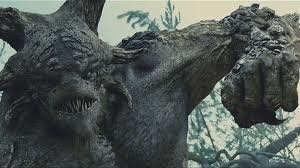

Wonderful fairy tale troll!
 Fairy tales are part of the dark mythological underbelly of civilisation, and many lessons and social commentaries exist today in these handed down tales. In like fashion, many books are simply repeats of or expansions upon eternal themes such as the quest/journey/coming of age etc. Anne R. Allen says: Experts don’t agree on the exact number of narrative plots, but there aren’t many. (Good post in case you think someone like James Patterson stole your plot!)


So how can we look at this film and learn some writing lessons?

Let’s check out the reviews. These comments (I've underlined the most telling) can be applied to writing.

Rotten Tomatoes: While it offers an appropriately dark take on the fairy tale that inspired it, Snow White and the Huntsman is undone by uneven acting, problematic pacing, and a confused script.

The Washington Post: Michael O’Sullivan says: Too many bad apples spoil a tale. Overlong, overcrowded, overstimulating and with an over-the-top performance by Charlize Theron as the evil queen Ravenna, the movie is a virtual orchard of toxic excess, starting with the unnecessarily sprawling cast of characters. Snow White and the Huntsman feels less like a movie than a deadly cocktail of movie clichés, all of which have been thrown into a blender, set to ‘slow’ and pureed for two hours.

The San Francisco Chronicle: “…which takes everything mythic about ‘Snow White’ and pounds it out until it's flat and dead. It takes something whose truth is elusive and turns it into a movie that's obvious and trivial. The fairy tale … suffers from a problem in its rhythm. It's not that its pace is too slow, but that it's too regular, and this lack of syncopation makes it feel slow.

Ouch!

A Writer’s Digest article advises: Analyze successful stories. They (writers) ask questions when reading and use their findings to help strengthen their work. For example:

• How does the writer make me want to turn the page?
• Why am I drawn to the lead character?
• When are the stakes raised?
• How does the writer integrate minor characters?
• What makes a scene work?
• What’s the key to conflict?
• How does the writer handle dialogue?

In my humble opinion, the problem with Snow White is that loads of bad stuff eclipsed loads of good stuff. A cleaner, simpler story, tighter pacing, consistent characterization, believable motivation, a good sub-text and backstory, and quicker links to the actually great action scenes would have transformed this film into a iconic version of a tried and tested tale of good triumphing over evil. People don’t get tired of a good story told well.

How well are you telling your story?

Tuesday, June 12, 2012

What Writers Can Learn From Prometheus!


So, what can writers learn from Prometheus?


I just watched the new Ridley Scott film Prometheus. Is it good? It’s great. But is it good? No, not really, if you’re interested in the story, the fact that it’s the prequel to the wildly successful Alien franchise, and if you’re a stickler for tying up loose ends. If you’re the kind of person who doesn’t mind threads not being carefully tied up by the end of a film or book, then don’t panic. Sometimes it’s good just to go along for the ride. But if you’re the pernickety kind of person that all writers should be, then pay attention.

Story: Set in the late 21st century, the story centres on the crew of the spaceship Prometheus as they follow a star map discovered among the remnants of several ancient Earth cultures. Led to a distant world and an advanced civilization, the crew seeks the origins of humanity, but instead discovers a threat that could cause the extinction of the human race.


Prometheus
 Now read this Forbes review, which posed many of the questions I asked myself as I walked out the theatre. How, why, when, why not, no, really, you can’t be serious, oh, please! – all the questions/comments readers/viewers should never have to ask at the end of a book/movie.

So, the lesson writers can learn from Prometheus is this: keep a tight hold on your story. Grab it by the tail and don’t let it go, not for a second.


Fatal Flaw #1: Unanswered Questions

Helpful Hint: Answer every question and tie up every thread by the end of your book. A nifty way of doing this is to make a synopsis of each chapter once you have written it. Then when you have finished your manuscript, and the accompanying synopsis for each chapter, read the manuscript backwards (yep, backwards) and check if you have answered every single question that an alert reader might raise. How did Character A get the amazing artifact? How or why did Character B get motivated to do whatever? Is the secret everyone’s been trying to discover actually worth all the trouble people took to conceal it? As you edit your own work, ask the questions as each character confronts them, and then write them down. By the end of your book, go back, read the questions, and answer them. If you can’t, then your reader can’t.

Fatal Flaw #2: Characters Doing Uncharacteristic Things

Helpful Hint: This was a big problem for me in the movie and so much so that the characters’ sometimes-idiotic behaviour actually diminished their authenticity for me. You’re asking readers (or in this case, moviegoers) to suspend their disbelief and join you in an incredible story that will move/excite/anger/do whatever to engage their emotions. So, make sure your characters behave like real people and that they don’t do things that are uncharacteristic just because you have to make your story move along.

Did I like the movie? I LOVED it, until I started asking myself all these niggling questions. But, I still loved it. I'll probably buy the DVD.